
Waltham Wood Flooring installs engineered hardwood flooring throughout Waltham, MA, serving surrounding cities including Belmont, Watertown, Lexington, Newton, Arlington, and after 20+ years here most of it goes into exactly the places where solid wood does not belong: finished basements, lower levels, floors over concrete, and rooms above heating systems that move a solid board every season.
Engineered wood gets discussed as a compromise, and that framing is wrong. It is real hardwood on the surface over a cross-laminated core, and the core is a structural answer to a structural problem.
Where moisture moves under a floor, a solid board will change width and cup no matter how skilled the installation. An engineered board in the same conditions stays flat. That is not a marketing distinction; it is how the two products are built.
What engineered flooring does require is honest specification. The wear layer decides whether it can ever be sanded, the core decides how it behaves, and the moisture readings decide the vapor retarder and the installation method. We take those readings in the actual space before recommending a product, because a basement that reads dry in September is not the same room in March.
What Engineered Flooring Actually Is
The construction is worth understanding before choosing, because every meaningful decision downstream follows from it. Two boards that look identical face up can be built quite differently underneath, and the differences are not visible once the floor is down. Reading a specification sheet before ordering is the only point at which any of this is within your control.
The Wear Layer
The wear layer is the hardwood surface — red oak, white oak, maple, hickory or another species — bonded to the core. Its thickness is the single most consequential number in the specification, because it determines how much material exists above the core and therefore whether the floor can ever be sanded and refinished rather than replaced.
The Core
Beneath the wear layer, plies are laminated with their grain running in alternating directions. Because wood moves far more across the grain than along it, crossing the plies means each layer restrains the next, and the assembly holds its width through humidity swings that would visibly move a solid board of the same species.
Tongue And Groove Against Click Locking
The edge profile matters as much as the core on a floating installation. A traditional tongue and groove edge is glued or fastened and behaves like a conventional floor; a mechanical click profile locks board to board without adhesive. The click systems install faster and come apart again, but they depend entirely on a flat substrate, since any dip works the joint loose over time.
How It Differs From Laminate And Vinyl Plank
Laminate is a printed photographic layer over fiberboard; luxury vinyl plank is a printed film over a plastic core. Neither contains hardwood, neither can be sanded, and neither ages the way wood does. They have their uses, but they are not in the same category as an engineered floor, and they should not be priced against one as if they were.
Where Engineered Wood Belongs In A Waltham House
The case for engineered flooring is almost always about what is underneath the room rather than what is in it. A room’s use, its furniture and its light have almost no bearing on the decision; the substrate, the level and the moisture reading have all of it. That is why we ask what is under the floor before asking what you want it to look like.
Basements And Finished Lower Levels
Below grade, vapor moves up through the slab continuously, and there is no installation method that prevents it. Solid hardwood put down there takes on moisture from below and cups, often within a single heating season. An engineered floor over an appropriate vapor retarder is the material that actually holds its shape in that environment.
Over Concrete Anywhere In The House
The same reasoning applies to any slab, including additions, sunrooms and garage conversions. A concrete substrate is a moisture source regardless of which floor of the house it sits on, so the flooring specification follows the substrate rather than the level.
Over Radiant Heat
Radiant systems cycle a floor through repeated warming and cooling, which is precisely the condition that opens gaps in solid strip flooring each winter. Engineered construction takes those cycles far better. The product and the adhesive both need to be rated for radiant use and the system’s surface temperature kept within the manufacturer’s limit.
Two-Family And Condominium Floors
Where there is a household below, sound transmission becomes part of the specification. A glued or floated engineered floor over an acoustic underlayment is often the assembly that satisfies a condominium’s own requirements, and those requirements sit in the association’s documents adopted under M.G.L. c.183A rather than in the building code.
Specifying It So It Lasts
Two engineered floors at the same price per square foot can have very different lifespans, and the difference is visible only in the specification. Wear layer thickness, core construction and board width are the three numbers that decide it, and none of them can be changed after the floor is bought. We go through all three before an order is placed rather than after the material arrives.
Wear Layer Thickness And Future Refinishing
If you want the option of sanding the floor once or twice over its life, that has to be bought at the outset in wear layer thickness. A thin sliced veneer looks identical when new and cannot be sanded at all. We are explicit about which product you are choosing and what it commits you to twenty years out.
Core Construction And Board Width
A plywood core generally behaves better than a densified fiberboard one, and the wider the board, the more the core is being asked to do. Wide plank engineered flooring is entirely workable, but it is not the place to economize on the core, because a wide board over a weak core is where delamination and edge lift show up.
Prefinished Against Site-Finished Engineered
Most engineered flooring arrives prefinished with a micro-bevel at the edges, which installs quickly with no finish odor and hides small height differences. Where a thick sawn wear layer is specified, an engineered floor can also be site-finished flat like solid wood, giving a single unbroken plane with no bevel lines.
Installation, Moisture And Getting The Substrate Right
The installation is where the specification either pays off or is wasted, and it starts with numbers rather than with adhesive. A well-specified floor installed over an unmeasured slab is no better protected than a poorly specified one, because the vapor retarder and the adhesive are both chosen from readings. Taking those readings costs an hour and decides the next twenty years.
Readings Before Anything Else
We take moisture readings in the slab or subfloor and in the space itself, and repeat them where the result is marginal. Those readings set the vapor retarder, the adhesive, and sometimes the decision not to install yet. Covering an active water problem with a new floor is the most expensive mistake available in this work.
Vapor Retarders And Underlayment
The retarder is what stands between the slab and the flooring, and it is chosen from the readings rather than from habit. Where acoustic performance is also required, the underlayment has to satisfy both demands at once, which occasionally narrows the options to a single assembly.
Glue-Down, Float And Nail-Down
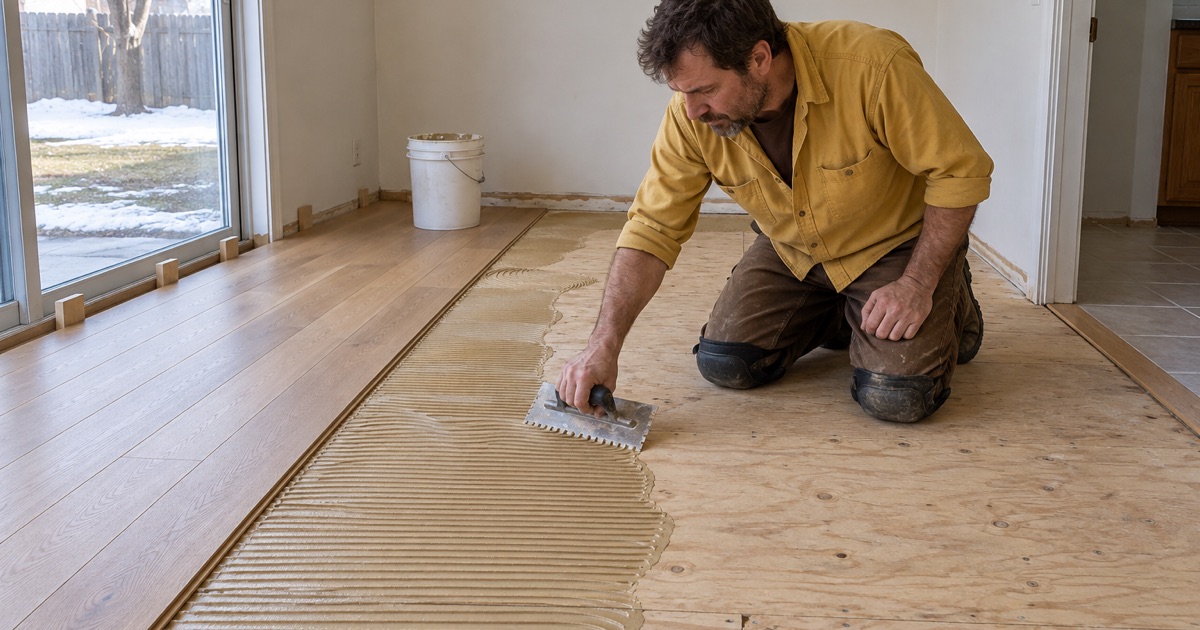
Over concrete the practical choices are glue-down, which is the quietest underfoot and the most stable, or a floating installation over underlayment, which is faster and more forgiving of a slightly uneven slab. Over a wood subfloor, engineered flooring can also be nailed. The substrate, the building and the association’s rules between them usually decide.
Acclimation And Expansion Gaps
Engineered flooring moves less than solid wood, but it still moves. It comes into the house, sits in the rooms it is going into, and is installed when its readings and the substrate’s agree, with proper expansion gaps at every wall, column and threshold. Skipping either step is how a floor that should have stayed flat ends up lifting at an edge.
- 20+ Years On Wood Floors
- Written Itemized Estimates
- Stain Samples On Your Own Floor