
Waltham Wood Flooring installs hardwood floors throughout Waltham, MA and serving surrounding cities including Belmont, Watertown, Lexington, Newton, Arlington, with 20+ years of putting new wood into houses that were built long before it. Most of our installation work is not a bare new-construction slab; it is a room in an older house where a subfloor, a stair, a doorway and an existing floor next door all have to be taken into account.
That is why an installation quote here starts with measurements rather than a material list. We read the moisture in the subfloor and the space, check the subfloor for flatness and movement, look at how the new floor will meet what is already there, and establish whether the level is on grade, above it, or below. Those answers narrow the material and the fastening method before anyone opens a catalog.
We install solid and engineered wood in strip, plank and wide plank, prefinished or site-finished, nailed, glued or floated. What we do not do is pick one method and make every house fit it.
Solid, Engineered And Where Each One Belongs
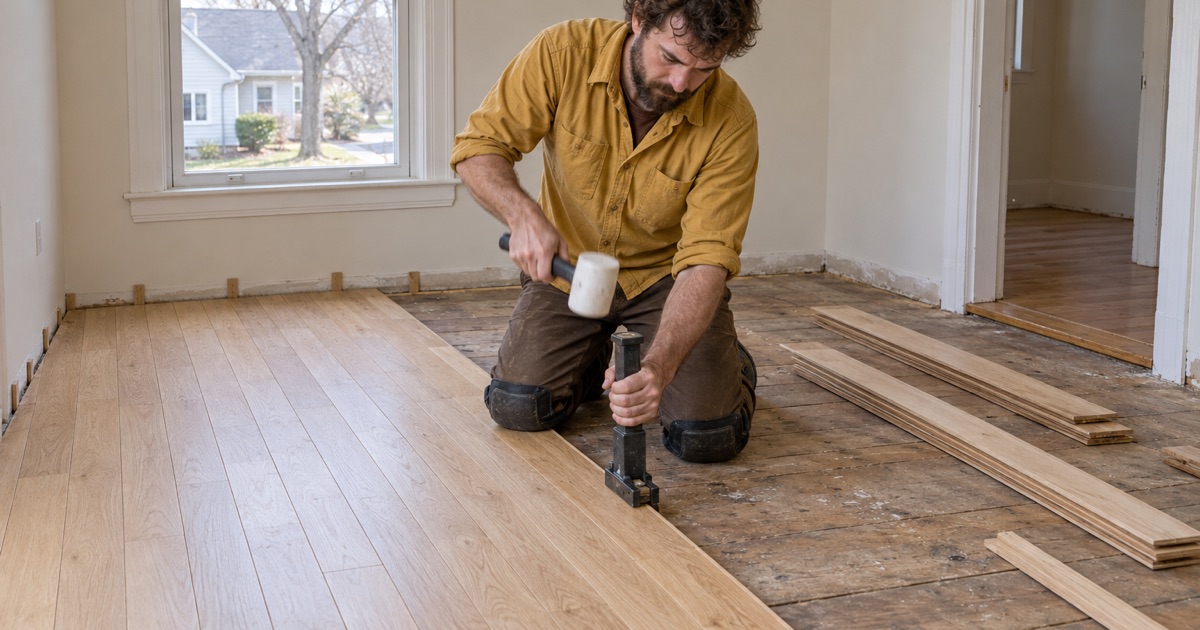
The distinction is about dimensional behavior, not quality. Both are real wood on the surface; they differ in how they respond to moisture underneath them. That difference decides where each one belongs far more reliably than price does, and getting it wrong is not a matter of taste — a solid board laid in the wrong place will tell you so within a single heating season.
Solid Hardwood On And Above Grade
Solid strip and plank flooring is one piece of timber through its full thickness, which is why it can be sanded many times over a long life. It expands and contracts across its width with the seasons, so it needs a wood subfloor, a controlled space and proper expansion gaps at every wall and vertical obstruction.
Engineered Wood Where Moisture Moves
Engineered flooring is a wear layer of real hardwood over a cross-laminated core, and that core is what keeps it flat where a solid board would cup. Below grade, over concrete, or over radiant heat it is the correct choice rather than a compromise. The wear layer thickness determines whether it can ever be sanded, so it is worth specifying deliberately.
Prefinished Against Site-Finished
Prefinished boards arrive with their coating cured and a micro-bevel at each edge, which hides small height differences and gets the room back in a day. Site-finished flooring is installed raw and sanded flat afterward, giving a single unbroken plane and a finish that can be recoated across the entire floor later without a visible boundary.
Species, Grade And Board Width
Species choice is a question of hardness, how the wood takes color, and what the rest of the house looks like. Grade is about the amount of character in the boards, not about quality. A select grade floor is calm and uniform; a lower grade carries knots, mineral streak and far more color variation, and in a house with a hundred years of other detail in it that often reads better than a floor with nothing going on.
Red Oak, White Oak And Hickory
Red oak is the New England default and takes stain predictably. White oak is harder, more dimensionally stable and has a cooler undertone that suits gray and natural finishes. Hickory sits higher again on the Janka hardness scale and carries dramatic color variation from board to board, which some people want and some do not.
Maple And Eastern White Pine
Hard maple is dense and closed-grain, which makes it excellent underfoot and difficult to stain evenly without conditioning. Eastern white pine is soft, dents readily and belongs in houses whose other details are of that period, where the marks it collects read as character rather than as damage.
Strip, Plank And Wide Plank
Narrow strip flooring is what most Waltham houses already have, and it is the quietest visual option in a small room. Wider boards show more of each piece’s figure but move more across their width, so acclimation, fastening and expansion gaps all matter more as the board gets wider, not less.
The Subfloor Decides The Installation Method
A new floor is only as flat and as quiet as what it is fastened to, and nothing about the finished surface can correct a substrate problem left underneath it. This is the stage where an installation is either made or quietly compromised, and it is also the only moment in the life of the room when the subfloor is genuinely accessible. Everything done here costs a fraction of what the same work costs once the floor is down.
Flatness, Fastening And Squeaks
We check the subfloor with a straightedge and correct what is out of tolerance before racking any material. Panels or boards that move against a joist are refastened from above or below while access exists, because a squeak that develops under a new floor is far harder to reach once the flooring, the baseboard and the furniture are back.
Moisture Readings And Acclimation
Moisture is measured in the subfloor and in the flooring itself, and the material stays in the rooms it is going into until the two readings agree. Installing on schedule rather than on readings is the single most common cause of winter gaps and summer cupping in an otherwise sound installation.
Nail-Down, Glue-Down And Floating
Nail-down suits solid wood over a wood subfloor and is fastened with cleats or staples driven through the tongue. Glue-down is used for engineered material over concrete and where sound transmission to a unit below matters. Floating installations sit on an underlayment and are sometimes the only method a condominium’s own rules permit.
Transitions, Trim And Meeting What Is Already There
The edges are where an installation is judged, and in an older house almost none of them are standard. Doorways are rarely square, floor heights change from one room to the next, and the stair at the end of the hall was built to suit a covering nobody has seen in forty years. Each of those is worked out on site rather than ordered from a catalog.
Reducers, Thresholds And Stair Nosing
Where a new floor meets tile, carpet or a floor of a different height, a reducer or threshold carries the difference without a trip edge. At the top of a staircase the nosing has to be matched to the new material and scribed to a stair that is rarely square, which is bench work rather than a stock part.
Weaving New Boards Into An Existing Floor
When an addition, a removed wall or a relocated outlet leaves new flooring meeting old, we rack the new stock into the existing courses in a staggered pattern with grain direction and board width matched, then sand and finish both areas together so the join disappears into the floor.
- 20+ Years On Wood Floors
- Written Itemized Estimates
- Stain Samples On Your Own Floor