
Waltham Wood Flooring installs herringbone, chevron and wide plank floors in Waltham, MA, serving surrounding cities including Belmont, Watertown, Lexington, Newton, Arlington. These are the floors where the layout matters more than the material, and where an installation done in a hurry shows it permanently from every angle in the room.
A patterned floor is a geometry problem before it is a flooring job. It is set out from a center line established in the room, not started from a wall, because a pattern that begins at an edge ends up visibly out of square by the time it reaches the other side. Every block has to register against its neighbors, and small errors accumulate rather than cancel.
Wide plank asks a different question. The material is straightforward to lay, but a wider board moves more across its width than a narrow one, so acclimation, moisture readings, fastening and expansion gaps all carry more weight. We treat wide plank as its own specification rather than as strip flooring in a larger size.
Herringbone And Chevron Are Different Floors
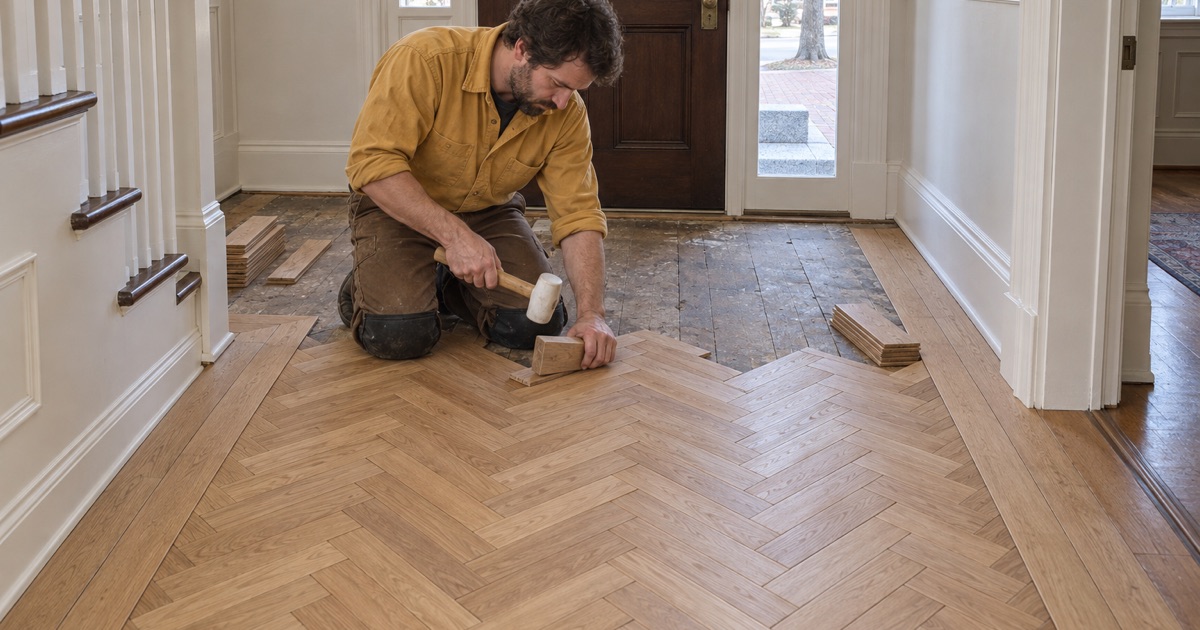
The two get used interchangeably in conversation and are not interchangeable in practice, in either the material or the labor. The blocks are cut differently, they cost differently, and they are set out from different reference lines. Getting the name right at the quoting stage matters because ordering one and expecting the other is not a change that can be absorbed on site.
Herringbone
Herringbone is made of rectangular blocks with square-cut ends, laid so the end of one piece meets the long side of the next at a right angle. The result steps across the floor in a zigzag with a broken line running through it. It is the more forgiving of the two to install, since the blocks themselves need no angled cuts.
Chevron
Chevron pieces are mitered on both ends, typically at forty-five degrees, so the points meet tip to tip and the pattern forms an unbroken V down the length of the room. The material costs more because of the cutting, and the installation is less forgiving: a chevron point that does not meet cleanly is visible from across the room.
Scale And Board Size
The size of the individual blocks changes the character of the floor completely. Small blocks read as a texture and suit a hall or a smaller room; large ones read as an architectural statement and need the floor area to carry them. We lay out a section on the actual floor before ordering so the scale is a decision rather than a discovery.
Laying Out A Patterned Floor
Most of the skill in this work happens before any adhesive or fastener is used. Once the first blocks are down, every piece that follows inherits their position, so an error at the start is not corrected later — it is amplified across the room. The layout stage is slow on purpose.
Establishing The Center Line
The pattern is set out from lines struck in the room, squared against each other and checked against the walls rather than assumed from them. In an older Waltham house almost no room is truly square, so part of the layout decision is which wall the inevitable discrepancy is pushed toward and how it is absorbed.
Waste And Ordering Material
Every perimeter piece is an angle cut, so waste runs well above what a straight floor generates. We calculate the quantity from the actual room dimensions and pattern scale rather than adding a standard percentage, and we order the whole floor in one batch so color and grade remain consistent across it.
Borders, Perimeters And Transitions
Patterned floors traditionally finish with a border or a plain perimeter band, which gives the pattern a clean edge and absorbs the out-of-square in older rooms. Where the floor meets a doorway or another material, the transition is worked out at layout stage, because a pattern running into a threshold at an awkward angle cannot be fixed later.
Wide Plank Floors
Wide boards show far more of each piece’s figure, which is the reason to choose them and the reason they need more care. Fewer boards means fewer joints and a calmer floor, and it also means each individual board is doing more work. None of that makes wide plank difficult; it makes the preparation stages less forgiving of being rushed.
Width, Movement And Expansion
Wood moves across its grain, so a board twice as wide moves roughly twice as far with the same change in moisture content. Expansion gaps at every wall and vertical obstruction have to be sized for that movement, and the fastening schedule tightened accordingly, or the floor finds its own way to relieve the stress.
White Oak And Hickory
White oak is the usual choice for wide plank: harder than red oak, more dimensionally stable, and with a cooler undertone that suits natural and gray finishes. Hickory is harder again on the Janka scale and carries dramatic color variation from board to board, which reads as character at width and as chaos to some eyes.
Acclimation And Fastening
Wide material comes into the house and sits in the rooms it is going into until its moisture content and the subfloor’s agree, with readings taken rather than days counted. Fasteners are placed more frequently than on strip flooring, and on the widest boards a combination of adhesive and mechanical fastening is often the right assembly.
Where These Floors Belong In This Housing Stock
Waltham has the building stock for both, and neither suits every room in it. A patterned floor belongs where it will be seen and where the rest of the room can carry it, and wide plank wants enough floor area for the width to register. Both look wrong squeezed into a space that is too small for them.
Period Houses And Their Own Details
In a house with substantial original millwork, a patterned floor reads as belonging rather than as an addition. Where the rest of the room has been stripped back to something plain, an elaborate floor can end up as the only ornament in the space, which is worth thinking about before the material is ordered.
Entries, Halls And Formal Rooms
The traditional home for herringbone and chevron is the part of the house people arrive in: an entry, a stair hall, a dining room. Those are also the rooms where a smaller area makes the cost manageable and where the pattern is seen from the standing and moving positions that show it best.
Repairing And Extending An Existing Pattern
Older patterned floors turn up here more often than people expect, sometimes under carpet. Repairing one means matching the block dimensions exactly, since the pattern will not close otherwise. We measure the existing pieces, cut or source stock to match, and finish the repaired area together with the surrounding floor.
- 20+ Years On Wood Floors
- Written Itemized Estimates
- Stain Samples On Your Own Floor