
Waltham Wood Flooring has been refinishing stairs in Waltham, MA for 20+ years, serving surrounding cities including Belmont, Watertown, Lexington, Newton, Arlington. Stairs are the part of a flooring job most often underestimated, and they are the part we quote tread by tread, because a staircase is not priced by the square foot and pretending otherwise produces an estimate nobody can hold.
A flight of stairs is a collection of small hand-worked surfaces. Each step has a tread, a riser, a nosing that has to be shaped rather than sanded flat, an exposed end or a skirt board against the wall, and frequently balusters and a newel that limit access to all of it. A machine touches very little of that. The labor is in the detail work, and the estimate says so openly rather than burying stairs inside a floor price.
In this housing stock there is also almost always paint somewhere on the assembly — risers, skirts, or the whole staircase under a carpet runner. Where the house predates 1978, stripping that paint falls under the Massachusetts lead-safe renovation rules, so we check the build year and the painted surfaces before a scope is written rather than discovering it mid-job.
Why A Staircase Is Its Own Job
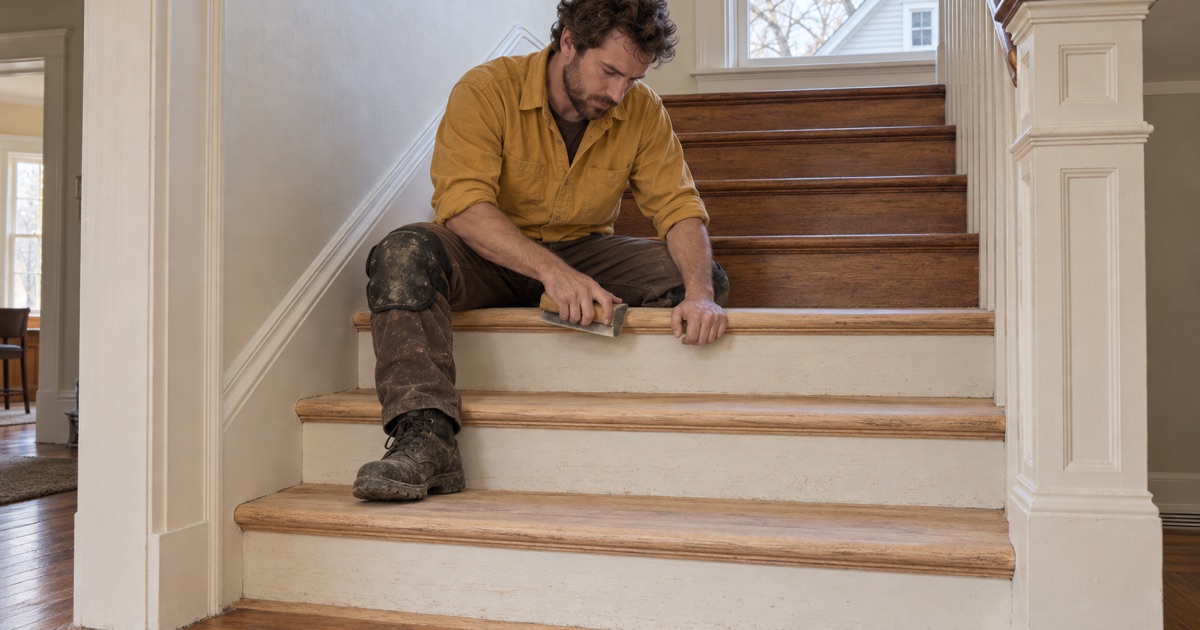
Everything that makes a floor efficient to refinish is absent on a staircase, and understanding that is what makes the quote make sense. There is no long uninterrupted run for a machine, no single plane to work across, and no way to move faster by taking a wider pass. The surface area is small and the number of separate operations is large, which is the reverse of every economy a floor offers.
Priced Step By Step
We count the steps, note which surfaces on each are being refinished, and price accordingly. A closed staircase with a skirt on both sides costs differently from an open one with exposed tread ends and balusters, and a winder or a landing changes it again. You see that breakdown rather than a single number for the flight.
Hand Work Instead Of Machine Work
A drum sander cannot reach a tread, an edger cannot shape a nosing, and neither goes anywhere near a baluster. Stairs are worked with small orbital sanders, scrapers and hand abrasive, which is why a flight takes a day or more of labor that a room of equivalent area would not.
Access, Dust And Keeping The House Usable
A staircase is the one surface a household cannot simply stay off. We plan containment at the top and bottom, run extraction to a HEPA vacuum, and where there is only one flight we work alternating steps so there is always a route between floors while the finish cures.
What Waltham Staircases Usually Have Under Them
The surprises on a staircase are almost always found in the first hour, which is why we look before quoting rather than after. What is under a carpet runner decides whether this is a refinishing job or a rebuild, and the two are not close in price. Ten minutes with a pry bar at the top and bottom of the flight is enough to settle it.
Carpet Over Treads That Were Never Meant To Show
A runner or wall-to-wall carpet on stairs sometimes covers full hardwood treads in good condition, and sometimes covers construction-grade material finished only at the edges. Under either there will be staples and tack strip along every step. We lift a section at the top and bottom to establish which case this is before any scope is written.
Painted Risers, Skirts And Stringers
Many older staircases here have natural treads with painted risers and skirt boards, which is a period-correct combination and often worth keeping. Where the paint is coming off instead, it has to be stripped rather than sanded through, and on a pre-1978 house that changes the method and the containment before it changes the price.
Worn Nosings, Loose Treads And Squeaks
The nosing takes the traffic, so it is usually the most worn part of the step and sometimes rounded past the point where sanding will restore the profile. Loose treads and squeaks are movement between the tread, the riser and the stringer, and they are repaired from below where there is access under the stairs.
Stripping Paint Under The Massachusetts Rules
This is the part of stair work that most changes a scope, and it is decided by the build year rather than by how the paint looks. Sound, well-adhered paint on a pre-1978 staircase is treated exactly the same way as paint that is flaking off, because the regulation is about disturbance rather than condition. That is not a judgment we make on site; it follows from the date the house was built.
Homes Built Before 1978
The Waltham Consolidated Plan for fiscal year 1995 estimated roughly 19,000 city housing units built before 1978 and therefore possibly containing lead-based paint, so in this market the pre-1978 case is the ordinary one rather than the exception. Build year and painted surfaces are established before anything is disturbed.
How The State Rule Works
Massachusetts runs its own renovation program under 454 CMR 22.00 instead of deferring to the federal rule. Disturbing more than six square feet of painted surface in a room makes the work Renovation Work under that regulation, and 454 CMR 22.11(9)(a) prohibits power sanding painted surfaces without HEPA exhaust in the first place.
Containment And Cleanup
In practice that means the stairwell is sealed off, the work area is covered, extraction runs to a HEPA vacuum rather than to a bag, and the cleanup at the end is part of the method rather than an afterthought. It is slower and it is scoped as such in the written estimate.
Finish, Sheen And How Stairs Wear
Stairs take more concentrated wear than any floor in the house, on a surface people look at from close range. A floor is seen from standing height across a room; a riser is seen from a few feet away at eye level, and a tread is seen from directly above. Every decision about finish and sheen is made against that, not against what the adjoining floor needs.
Durability On Treads
A tread carries the whole load of each step on a narrow band near the nosing, so the finish there fails first. We build the coating on treads to suit that, and are straightforward about the fact that a staircase in daily use will want attention sooner than the floor it leads to.
Sheen And How A Step Reads Underfoot
Gloss on a tread reads as slippery whether or not it measures as such, and it shows every mark on a riser at eye level. Satin and matte sheens wear more gracefully and suit an older staircase, and we keep the stairs and the adjoining hall at the same sheen so they read as one piece of work.
Matching The Hall Floor
Stairs almost always meet a hall or landing floor, and a mismatch there is the first thing a visitor sees. Where both are in scope we sand and finish them together. Where only the stairs are being done, we show you the color against the existing floor before the finish goes on.
Our Step-By-Step Stair Refinishing Process
Assessment And A Test Lift
We lift a section of covering, establish what the treads and risers actually are, check the build year and the painted surfaces, and identify loose or worn steps. Everything found goes into the estimate as its own line so there is no renegotiation once the carpet is off.
Removal, Repairs And Paint Stripping
Carpet, pad, staples and tack strip come off without splintering the tread edges. Loose treads are refastened, worn nosings are repaired or replaced, and any paint in scope is stripped under the containment the job requires rather than sanded through.
Sanding Each Surface By Hand
Treads, risers, nosings and skirts are worked individually through a grit sequence sized to each surface. Corners, tread returns and the joints against balusters are done by hand, which is where the hours go and where the difference between a good and an indifferent staircase shows.
Finishing In Sequence So The Stairs Stay Usable
Where there is a second route between floors the flight is finished in one pass. Where there is not, we coat alternating steps and return for the rest, so the household keeps a way upstairs throughout. We tell you the cure schedule for each stage before we start, not as it happens.
- 20+ Years On Wood Floors
- Written Itemized Estimates
- Stain Samples On Your Own Floor