
Waltham Wood Flooring has been doing wood floor refinishing in Waltham, MA for 20+ years, serving surrounding cities including Belmont, Watertown, Lexington, Newton, Arlington. Refinishing is the largest part of what we do, because most of the floors here are worth saving: they are solid strip flooring laid before anyone thought of it as a finish surface to be replaced, and they respond well to being taken back to bare wood.
A refinishing job is decided long before a sander is switched on. We measure how much wood is left above the tongue, test what is already on the surface, read the moisture in the boards and the subfloor, and look at what has to be repaired before anything can be sanded flat. Those four answers set the scope, the price and the schedule, and they are the reason two floors of the same size can be very different jobs.
We work on occupied houses more often than empty ones, so containment, extraction and the order rooms come back into use are planned with you at the start. Where the house was built before 1978 and painted trim or stair parts are in the work area, the job is scoped under the Massachusetts lead-safe renovation rules rather than treated as ordinary sanding.
Deciding What A Floor Actually Needs
The most expensive mistake in refinishing is committing to the wrong scope. A full sand on a floor that only needed a recoat throws away wood that can never be put back; a recoat on a floor that needed sanding looks fine for a year and then shows every mark that was sealed under it.
Wear In The Finish Against Damage In The Wood
Traffic lanes down a hallway or in front of a sink are the first thing to look at. While the wear is still confined to the coating, the wood underneath is clean and a screen and recoat will restore the whole floor. Once the exposed timber has grayed or absorbed grime, the discoloration is in the wood itself and comes out only with abrasive.
How Much Wood Is Left Above The Tongue
Solid strip flooring can be sanded until the surface approaches the tongue, and after that the fasteners come into play. We read the remaining thickness at a register cut, a threshold or a stair nosing rather than guessing from the age of the house. Postwar flooring from the 1950s and 1960s is thinner to start with, so it gets measured every time before a full sand is proposed.
What The Existing Surface Will Accept
Decades of paste wax or oil soap leave a residue that nothing bonds to, and old shellac behaves the same way under a modern coating. Both are invisible. We test the surface in several places, because the result decides whether this is a one-day recoat or a full sand, and finding out afterward means doing the work twice.
Repairs That Have To Happen First
Loose boards, a soft patch of subfloor, black pet urine staining that reached below the finish, or the round holes left where steam radiators came out all have to be dealt with before the floor can be sanded as one surface. Patches are woven into the existing courses with matching stock so the repair disappears into the run rather than sitting in it.
Our Step-by-Step Wood Floor Refinishing Process
Assessment, Moisture Readings And Scope
We walk the floor, test the existing finish, take moisture readings in the boards and the subfloor, and measure the wear layer. Anything found — a failing patch, a wet lower level, resilient tile under carpet — goes into the written estimate as its own line, so you see what is flooring work and what is something else that has to happen first.
Repairs And Board Replacement
Damaged boards are cut out and replaced with matching stock racked into the surrounding courses in a staggered pattern. Squeaks are fastened from below where there is access. Radiator holes and the strips left by a removed wall are woven in at this stage, while the whole floor is still going to be sanded flat afterward.
The Grit Sequence And Edge Work
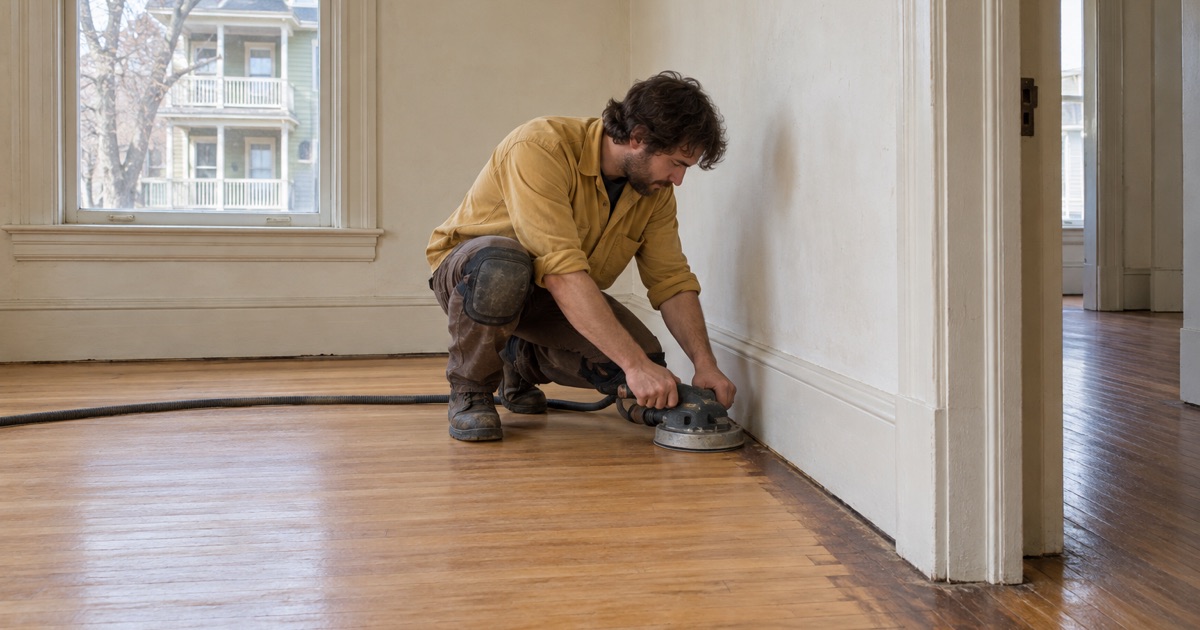
Sanding runs through a sequence of progressively finer grits, each one removing the scratch pattern left by the last. Skipping a grit is what leaves swirl and chatter visible under the finish. The drum sander handles the field, an edger takes the perimeter, and corners and stair returns are worked by hand so the whole surface reads as one plane.
Water Popping, Stain Samples And Color
Where the floor is being stained, we raise the grain first if the species and the color call for it, then lay the shortlisted colors directly on your sanded floor. You look at them in the room’s own daylight and again under lamps at night. Only then is a color committed across the whole space.
Coats, Cure Time And Rooms Coming Back
The finish goes down in coats with abrasion between them, and we schedule around which rooms you need first. We are explicit about the difference between walkable and cured, because furniture and rugs returning too early is the most common way a good finish gets marked in its first week.
Finishes, Sheens And The Massachusetts VOC Limits
Massachusetts sets its own VOC limits for wood coatings under 310 CMR 7.25(11), and they are stricter than the federal ones. Every product we specify is chosen to comply with the state limit, which narrows the field but does not narrow it to one answer.
Waterborne Polyurethane
Waterborne finishes cure clear and stay close to the wood’s natural color rather than ambering over time, which is what most people want when they are taking an orange oak floor back to something neutral. They also recoat quickly, which shortens the time a household spends working around the job.
Oil-Modified Polyurethane
Oil-modified polyurethane goes on with a warmer tone that deepens as it ages, which suits a traditional look and matches an existing floor in an adjoining room more easily. It takes longer between coats and carries more odor while curing, so it fits an empty house better than an occupied one.
Hardwax Oil
Hardwax oil penetrates rather than forming a film on the surface, so worn areas can be spot-repaired later without recoating the whole floor. It reads matte and feels like wood rather than like a coating. It asks more of the owner in maintenance, and we say so before anyone chooses it.
Sheen Level
Sheen is not a detail. A high gloss reflects every ripple in an old floor and shows dust within a day; a matte or satin sheen hides both. On a hundred-year-old floor that has moved with the house, the lower sheen levels are almost always the better read.
The Floors We Refinish In Waltham
Red Oak Strip Flooring In Prewar Houses
With 28.3 percent of Waltham’s housing units built before 1940, narrow red oak strip over a board subfloor is the default here. These floors have usually been covered at some point, have some cupping from a long-ago leak, and take a sanding well once the repairs are done.
Postwar Oak In 1950s And 1960s Houses
Waltham added 4,067 housing units in the 1950s and 2,948 in the 1960s, and their oak floors are thinner than prewar stock. Sanding one is still usually better than tearing it out, but only after the wear layer has been measured. Where the measurement comes back short, we say so and recommend a recoat instead.
Eastern White Pine And Maple
Old pine needs a gentler grit sequence than oak because the wood is soft, and maple is dense and closed-grain, which makes it prone to blotching under stain. Both are refinishable and both reward being treated as their own species rather than run through an oak routine.
- 20+ Years On Wood Floors
- Written Itemized Estimates
- Stain Samples On Your Own Floor