
Waltham Wood Flooring screens and recoats hardwood floors across Waltham, MA, serving surrounding cities including Belmont, Watertown, Lexington, Newton, Arlington, and in 20+ years it remains the most underused option in this trade. A great many floors that people assume need sanding need nothing of the kind: the wear is still in the coating, the wood underneath is clean, and a day’s work restores the whole surface.
The distinction is straightforward. A full sand removes wood and cannot be undone; a screen and recoat removes only the top of the existing finish and adds a fresh layer over it. That makes it far cheaper and faster, and it costs the floor none of its remaining life. It also means a recoat fixes nothing that is in the wood itself, which is why we test before quoting rather than after.
The test that matters most is whether anything will bond. Decades of paste wax or oil soap leave an invisible residue that no polyurethane grips, and a floor in that condition has to be stripped or sanded instead. Finding that out at the assessment costs nothing. Finding it out after coating costs the entire job twice over.
What A Screen And Recoat Actually Does
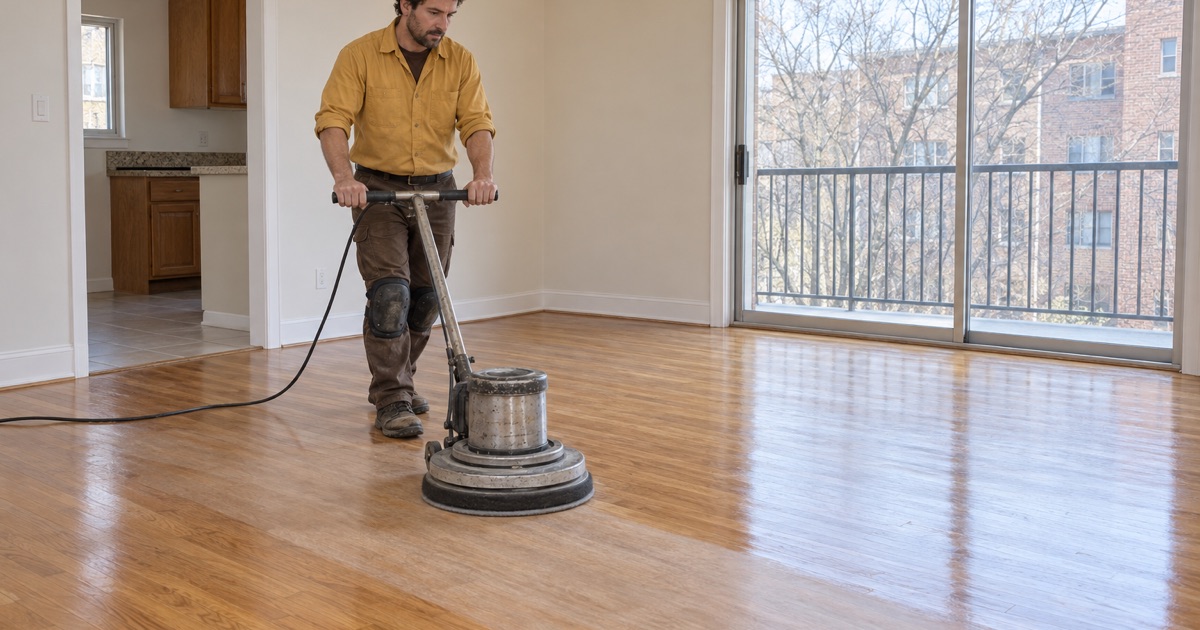
The process is short, which is exactly why it is worth understanding before choosing it. A day’s work on a floor sounds like a small intervention, and in terms of disruption it is. What it does to the floor is narrow and specific, and knowing exactly where that boundary sits is the whole basis of choosing it well.
Abrading The Existing Finish
A buffer fitted with a fine abrasive screen cuts the surface of the existing coating, leaving a uniformly roughened layer for the new finish to key into. The abrasive is deliberately fine: the intention is to scuff the coating, not to cut through it and expose the wood at the edges of the room.
One Day, One Coat
Rooms are cleared, the perimeter and corners are worked by hand, the field is screened, the whole area is vacuumed to a HEPA machine and tacked off, and the finish is applied. With a waterborne polyurethane the floor is usually walkable in socks the same evening, and the household is back in the room the following day.
What It Costs Against A Full Sand
A recoat is a fraction of the price of a full refinish, because there is no grit sequence, no edger work, no repair stage and no multi-day schedule. That gap is what makes the assessment worth doing properly: it is the difference between a day’s work and a week’s, on floors that can look very similar from a standing position.
Whether Your Floor Qualifies
Two questions decide it, and they are independent of one another. A floor can pass the first and fail the second, or the reverse, and either failure rules a recoat out on its own. Both are answered on site in a few minutes, and neither can be answered reliably from a photograph.
Wear In The Coating Or Damage In The Wood
Traffic lanes in a hallway or in front of a sink are the place to look. While the finish has thinned but still covers the wood, a recoat restores the whole floor. Once the exposed timber has grayed or taken on dirt, that discoloration is in the wood and a recoat will simply seal it under a fresh gloss.
The Wax And Residue Test
We test the surface in several places, because one room may have been maintained differently from the next. A positive result does not mean the floor is in bad condition; it means the maintenance history rules out a recoat. That floor needs stripping or a sand to bare wood, and the estimate changes accordingly.
Prefinished And Factory-Coated Floors
Factory finishes are harder and sometimes carry surface treatments intended to resist exactly the kind of adhesion a recoat depends on. We abrade a test area and check that the screen is cutting rather than burnishing, then judge from that. Where a factory coating will not take a site-applied finish, we say so rather than trying.
What A Recoat Will Not Fix
Being clear about the limits is what keeps this from being a disappointing job. A recoat that was never going to solve the thing you were unhappy about will still be a technically good recoat, which is no comfort at all. We would rather rule it out at the assessment than have you pay for it and be right about the floor afterward.
Stains, Gouges And Grayed Wood
Pet stains, water marks, deep scratches into the timber and grayed traffic lanes are all in the wood. A recoat leaves every one of them exactly where it is, now under a fresh layer of finish. If those marks are the reason you are considering the work, a full sand is the only thing that addresses them.
Cupping, Gapping And Movement
A recoat adds a film a fraction of a millimeter thick. It does not flatten a cupped board, close a winter gap, quiet a squeak or level a floor that has moved with the house. Those are repair and refinishing questions, and they are priced as their own work.
Changing The Color
Stain goes into bare wood, so a recoat cannot change the color of a floor. Choosing a clear finish with a different sheen will change how the existing color reads, sometimes considerably, but taking an orange oak floor to something neutral means sanding to bare timber first.
Keeping A Floor On A Recoat Cycle
The real value of this work is preventive, and it depends entirely on timing. A recoat is cheap because it happens while there is still something to protect, and it stops being available the moment there is not. Treating it as routine maintenance rather than as a repair is what keeps a floor out of the sander for decades.
Recoating Before The Finish Wears Through
The whole economy of a recoat disappears the moment the wood is exposed. A floor recoated while its coating is thin but intact may never need sanding again in its owner’s tenure. The same floor left another two years becomes a full refinish, and a few millimeters of its life are gone permanently.
Maintenance Between Recoats
What goes on a floor between coatings decides how long the coating lasts and whether it can be recoated at all. Wax and oil-soap products are the ones that close the door. Grit is the other enemy, since it works as an abrasive underfoot, and mats at the doors do more for a finish than any product.
How Many Cycles Before A Full Sand
Because no wood is removed, a floor can go through multiple recoats. What eventually calls for a sand is accumulated coating thickness, or damage reaching the wood, or a change of color. We keep track of what has been done and tell you plainly when a floor has reached the point where sanding is the honest answer.
- 20+ Years On Wood Floors
- Written Itemized Estimates
- Stain Samples On Your Own Floor